Tables or desks

Diposting oleh fatih on Selasa, 20 Maret 2007

Anne,

I enjoyed your presentation yesterday and can easily imagine that you are a superb classroom teacher. At PBCC, we are building a new academic building that will have a wireless network for instruction. We are planning to initiate a computers in composition program using carts of laptop computers. I think you mentioned in your presentation that the students prefer tables to desks when working with laptops. We are looking at flexible furniture for these room—wheeled chairs and individual desks—see below—but I am now wondering if tables might be better. Your thoughts on this and anything else about using laptops to teach composition would be greatly appreciated.

Jim Mabry

Dr. James C. Mabry
Dean of Academic Affairs
Palm Beach Community College
South Campus
(561) 862-4410

What do you guys think?
Read More

A New Kind of Rhyme Podcasts

Diposting oleh fatih on Rabu, 28 Februari 2007

Towards the end of the poetry unit, Maura Moritz suggested having the Honors students podcast at least one of their poems. The kids were very receptive to do this as you can tell with the creativity in their poem choices that they selected to read. It adds so much to their own work by having them read it to their audience in the manner it was intended rather than the audience only being able to interpret the poem on their own. Happy listening!

Please note there are four players below (the Odeo player only allows 20 at a time). The first two players are for Period 2, then the next two are for Period 5.


Read More

A New Kind of Rhyme

Diposting oleh fatih on Rabu, 21 Februari 2007

Imagine: A place where students are adults and teachers are students. Imagine: A place where information is pulled, not fed. Imagine: A place where poetry can be real, deep, and fun at the same time.

Welcome to Ms. Smith's 9th Grade Honors English Class!!! Beware: This is NOT education as usual, please come prepared to learn in a way never experienced before. Please come excited to try new things, and to do your best, no matter the outcome. The same ideas will never be taught twice, but it will be a blast of fun!

That's what Ms. Smith told all of our expectant faces on the first day of our poetry unit. By now, we thought we were used to her new methods and challenging expectations, but we realized that poetry wasn' t like anything we'd learned before. And Ms. Smith never wanted to teach the same way twice.

So boom! Out came student-taught poetry explications, publishing of our poems, and a opportunity that, instead of ogling Shakespeare's brilliance, we could to create our own! And our poems wouldn't simply be pieces of paper with a red grade, they would be published on the world-wide internet for others to enjoy and reply with their feedback.

The limits of blogging were pushed past the max as, each night from my computer at home, I would post the rough draft of one of my poems. Then I could scroll through all my classmates' poems, and discover new ideas and ways to improve. The next time I checked back, it was thrilling to read others' comments and feedback. It felt like a giant fishbowl, where instead of agonizing over a poem by myself, I could throw it out to a ton of different minds and we could build it up together, achieving an end result that I knew was truely my very best work.

Of course, it also helps to learn from the professionals. Instead of Ms. Smith, who already knows what she is teaching, my fellow students and I stepped up to the plate. Working in teams of three, we selected published poems on the internet to interpret and explicate during class. From Dr. Seuss to Edgar Allen Poe, fishbowls to debates, and self-improvement to physically acting it out, each group came up with a brand new, yet creative way to reach deep inside a poem and find the true meaning. We learned and experienced every literary term, and discovered how we could apply that to our own writing. And the best thing was that we were a team working to learn together, instead of a regular class just being lectured by the normal teacher.
And the end result was amazing! We all compiled our poems into a portfolio project that only had one guideline: display all your poems in a creative way. With such an open-ended project, our talents had no limit, and together we were each able to create a product that was nothing like the same, old, regular portfolio. We could dare to be different, and reflect each of our minds in a manner suited to our personality and learning style.

I know I will never think or write poetry the same again! - Maria


Here are the assignments they completed. Keep on the lookout for their podcasts of their poems.

http://annesmith9h.blogspot.com/2007/02/cut-up-poem-destruction-of-sonnet.html

http://annesmith9h.blogspot.com/2007/02/oprah-winfrey-poem.html

http://annesmith9h.blogspot.com/2007/02/metaphor-3.html

http://annesmith9h.blogspot.com/2007/02/metaphor-2.html

http://annesmith9h.blogspot.com/2007/02/metaphor-1.html

http://annesmith9h.blogspot.com/2007/02/persuasive-poem.html

http://annesmith9h.blogspot.com/2007/02/poetry-table-of-contents-poem.html
Read More

A Study Of The Sun

Diposting oleh fatih on Selasa, 30 Januari 2007

The past couple of years, I have been lucky enough to teach something that is a hobby to students. I am not really an expert in Astronomy but I do like to study it in a recreational format. That led me to establish a class on Astronomy at AHS. The class usually fills with seniors and since there is only one section, it is a bit more relaxed than the chemistry classes that I teach. However, the past couple of years, I have stood at the front of the room at the beginning of the semester and presented material about our closest star (the Sun, just in case). Usually the students spend the time checking their eye lids for any signs of "leaking light." So, I thought I would try something different...

With the access to the computers and a seemingly endless supply of images on-line I set my stents out on a hunt.
  1. Find out what some of the terms are that describe features of the Sun.
  2. Collaborate with other students about descriptions dealing with the Sun.
  3. Find images showing examples of the features of the Sun.
  4. Use the information that they generated to identify features of the Sun on images that I found.

I was amazed. Not only were they excited about looking at images of the Sun, they were looking at images of other things dealing with Astronomy at they were discussing them. There were some images that the students had difficulty interpreting and they even returned to their computers to continue research and eventually decided on the identification of the images. This was becomming a dream for me. I was able to watch a diverse group of studetns start on the same path, find information, put it into an organized format, and then use the information to analyze and interpret additional data. We were doing science! It sure is nice when there is the time to do something right.

Read More

What Matters...

Diposting oleh fatih on Kamis, 14 Desember 2006

All semester long, my students have been examining the big question of “What Matters?” What matters to them in their own lives, what matters to them from each piece of literature we studied, and most importantly, how does that all relate to the world around us. At the beginning of the semester, I told my ninth graders I wanted them to create a Photo Story showing the connections of what matters. I didn’t have an example to show them what I expected; I just wanted them to show me what they could do. I wanted them to create what was important and meaningful to them as well as for them to decide how it should look.

They have spent many hours not only learning the Photo Story 3 software (I really only had basic training when I introduced this assignment), but planning, finding visuals, editing audio clips for their script as well as for music, pasting and inserting sound and visuals, and reworking the elements for a finished project. I can definitely say this has been a learning experience for all of us, but I am glad we all undertook it. Linked are some notes on tips we have learned along the way. I think after seeing each others’ presentations, they will feel the same way.

Please comment on the presentations giving them constructive feedback.

http://www.lps.k12.co.us/schools/arapahoe/smith/connorf.wmv
http://www.lps.k12.co.us/schools/arapahoe/smith/davidr.wmv
http://www.lps.k12.co.us/schools/arapahoe/smith/kelleys.wmv
http://www.lps.k12.co.us/schools/arapahoe/smith/lyndseyd.wmv
http://www.lps.k12.co.us/schools/arapahoe/smith/sarahw.wmv
http://www.lps.k12.co.us/schools/arapahoe/smith/zoey.wmv

http://www.lps.k12.co.us/schools/arapahoe/smith/AshleighC.wmv
http://www.lps.k12.co.us/schools/arapahoe/smith/AlexB.wmv
http://www.lps.k12.co.us/schools/arapahoe/smith/AshleighM.wmv
http://www.lps.k12.co.us/schools/arapahoe/smith/ColeH.wmv
http://www.lps.k12.co.us/schools/arapahoe/smith/DeirdreC.wmv
http://www.lps.k12.co.us/schools/arapahoe/smith/GarrettS.wmv
http://www.lps.k12.co.us/schools/arapahoe/smith/JohnM.wmv
http://www.lps.k12.co.us/schools/arapahoe/smith/JohnS.wmv
http://www.lps.k12.co.us/schools/arapahoe/smith/JordanR.wmv
http://www.lps.k12.co.us/schools/arapahoe/smith/JosephS.wmv
http://www.lps.k12.co.us/schools/arapahoe/smith/KaylaC.wmv
http://www.lps.k12.co.us/schools/arapahoe/smith/KelliL.wmv
http://www.lps.k12.co.us/schools/arapahoe/smith/KeriN.wmv
http://www.lps.k12.co.us/schools/arapahoe/smith/MattD.wmv
http://www.lps.k12.co.us/schools/arapahoe/smith/NicholasP.wmv
http://www.lps.k12.co.us/schools/arapahoe/smith/PatS.wmv
http://www.lps.k12.co.us/schools/arapahoe/smith/PhilH.wmv
http://www.lps.k12.co.us/schools/arapahoe/smith/QuinnB.wmv
http://www.lps.k12.co.us/schools/arapahoe/smith/RichardM.wmv
http://www.lps.k12.co.us/schools/arapahoe/smith/ToreinM.wmv
Read More

Skype v. Blogger: The Battle of the Fishbowl

Diposting oleh fatih on Rabu, 06 Desember 2006

Instead of using Blogger to continue the outside circle’s discussion of the assigned chapters for Fishbowl, we tried out Skype. Skype is a free program which enables people to make free calls over the Internet to other Skype users. It also provides an instant-messaging type service for groups to communicate with one another in a “chat room” setting.
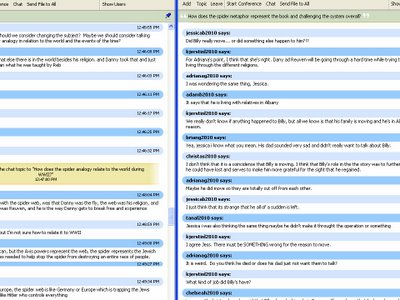


The students signed up for accounts through Skype and added me to their contact list. We made sure to communicate with the students the importance of not publishing any personal information over the Internet and encouraged them to use their Blogger display name along with an additional set of characters as their Skype username (both for safety and to create a unique username).After a few glitches, we were able to get everyone added and connected to one another. We completed some initial test runs with practice questions balancing two chat sessions occurring at the same time. We displayed the conversation side by side on their screens as well as projected onto the screen at the front of the classroom. At first it was truly mesmerizing to see how fast they were posting. However, it raised some interesting pedagogical questions regarding depth and quality of insight. My hope of using Skype versus Blogger was to use multiple online conversations with the outer circle in tandem with the inner circle conversations of the fishbowl. With Blogger, we created one post and the students commented on that. Even if we created multiple posts in Blogger, it would be difficult for students to follow multiple conversations due to the refresh issues.

When using Skype with the Fishbowl technique, I was looking for how it enhanced or detracted from the conversation. With Skype students noticed the conversation moved at a much faster pace allowing for them to comment more frequently, but at the same time, they put less thought into what they posted. Once again we, as a class, went back to the drawing board establishing Skype guidelines while reflecting on our Blogging guidelines. We had to focus on what it was we did well and liked about Blogger, but at the same time how could we make Skype better while increasing our learning and collaboration without sacrificing the quality of conversation.

It was really amazing to see them connect so easily to one another in the two smaller outside circle groups. I had split up the outer circle into the two smaller conversations so that the connections could be more instantaneous and lively. I also enjoyed hearing and seeing their connections between the conversations from the inner and outer circle as well as between the two Skype conversations. They did a much better job after reflection and analysis of referencing one another, using complete sentences, and expressing complex thoughts. In addition, since we are using an inquiry based approach to this entire semester focusing on the question of “what does it take to challenge the system?” I have been impressed to see how easily the students connect back to previous pieces of literature we have studied (Macbeth, Inherit the Wind, The Chosen, Fahrenheit 451) as well as referencing common themes and motifs they see reoccurring through each (appearance v reality, relationships between men and women-marriages, hands, eyes, challenging the system, price of progress, ambition, power).

Skype is still up for debate, but the students really seem to see the value in it as seen from their commenting to the posts regarding its trial run in class. Also, within the links below, please read through the transcripts of their conversations :

http://annesmith9h.blogspot.com/2006/11/chosen-fishbowl-1-3-period-2.html

http://annesmith9h.blogspot.com/2006/11/chosen-fishbowl-1-3-period-5.html

http://annesmith9h.blogspot.com/2006/11/reflecting-back.html

The Chosen Period 2 Fishbowl Group One

The Chosen Period 2 Fishbowl Group Two

The Chosen Period 5 Fishbowl Group One

The Chosen Period 5 Fishbowl Group Two


As for me, the verdict is still out on Skype. I am impressed by my students’ abilities with multi-tasking and the quality of conversation available to them through Skype. I agree that it is much faster paced allowing for their conversation to develop as fast as they want; but at the same time, I appreciate it more when they slow down and listen to one another. It was really important to have a conversation with them about the purpose behind Skype and more importantly, behind fishbowl. After we completed a few Blogger and in class reflections, now they are doing a more comprehensive job commenting and connecting with one another using Skype than they did with Blogger. I guess I just thought that I would not have to re-teach the things they did so well with Blogger. In my mind, it just took longer to get them to that “good” place than it had previously.

Regardless of either using Skype or Blogger, the growth in my students’ learning with the use of these technological pieces and fishbowl has been tremendous. They connect every piece of text we have studied this semester to each other as well as see connections with themselves as learners and with the world around them. They can produce interesting, captivating thoughts and are learning to value one another’s opinions and insights. They are learning and teaching one another! Isn’t that what education should be all about? Before Blogger and Skype, I was the only one who could witness their growth as learners because the fishbowl had to feed through me before my students had access to the technology. Now that they have the technology they are able to see each other’s thoughts and growth as teachers and learners. This is NOT education as usual.
Read More

Romancing Your Computer

Diposting oleh fatih on Selasa, 28 November 2006

While 12 of my Honors American Literature students were in Hawaii, I decided do to a little experiment with the somewhat grumpy students who were left behind. I gave them the following objective: Develop your own understanding of American Romantic poetry based on the resources in your book; select and incorporate at least one extension, such as Romantic art, Romantic music, British Romantic poetry, or your own, original Romantic poetry. Use Photostory to present your findings.

I showed them how to use Photostory, helped them individually with interpreting tough poems, and then just gave them time. The results were impressive, and discussing the poems in small groups with individual attention was much more effective and engaging than discussing the poems with the whole class.

When we shared the Photostories in class, students voted on the following categories: Most Deeply Analytical, Most Sublime, and Most Creative and Entertaining. The winners are worth taking a few minutes to enjoy if you have time:

Kelm/Prado
Wilcox/Hunt
Crellin
Parietti/Lueders
Pullara/Harden
Read More