A Study Of The Sun

Diposting oleh fatih on Selasa, 30 Januari 2007

The past couple of years, I have been lucky enough to teach something that is a hobby to students. I am not really an expert in Astronomy but I do like to study it in a recreational format. That led me to establish a class on Astronomy at AHS. The class usually fills with seniors and since there is only one section, it is a bit more relaxed than the chemistry classes that I teach. However, the past couple of years, I have stood at the front of the room at the beginning of the semester and presented material about our closest star (the Sun, just in case). Usually the students spend the time checking their eye lids for any signs of "leaking light." So, I thought I would try something different...

With the access to the computers and a seemingly endless supply of images on-line I set my stents out on a hunt.
  1. Find out what some of the terms are that describe features of the Sun.
  2. Collaborate with other students about descriptions dealing with the Sun.
  3. Find images showing examples of the features of the Sun.
  4. Use the information that they generated to identify features of the Sun on images that I found.

I was amazed. Not only were they excited about looking at images of the Sun, they were looking at images of other things dealing with Astronomy at they were discussing them. There were some images that the students had difficulty interpreting and they even returned to their computers to continue research and eventually decided on the identification of the images. This was becomming a dream for me. I was able to watch a diverse group of studetns start on the same path, find information, put it into an organized format, and then use the information to analyze and interpret additional data. We were doing science! It sure is nice when there is the time to do something right.

Read More

What Matters...

Diposting oleh fatih on Kamis, 14 Desember 2006

All semester long, my students have been examining the big question of “What Matters?” What matters to them in their own lives, what matters to them from each piece of literature we studied, and most importantly, how does that all relate to the world around us. At the beginning of the semester, I told my ninth graders I wanted them to create a Photo Story showing the connections of what matters. I didn’t have an example to show them what I expected; I just wanted them to show me what they could do. I wanted them to create what was important and meaningful to them as well as for them to decide how it should look.

They have spent many hours not only learning the Photo Story 3 software (I really only had basic training when I introduced this assignment), but planning, finding visuals, editing audio clips for their script as well as for music, pasting and inserting sound and visuals, and reworking the elements for a finished project. I can definitely say this has been a learning experience for all of us, but I am glad we all undertook it. Linked are some notes on tips we have learned along the way. I think after seeing each others’ presentations, they will feel the same way.

Please comment on the presentations giving them constructive feedback.

http://www.lps.k12.co.us/schools/arapahoe/smith/connorf.wmv
http://www.lps.k12.co.us/schools/arapahoe/smith/davidr.wmv
http://www.lps.k12.co.us/schools/arapahoe/smith/kelleys.wmv
http://www.lps.k12.co.us/schools/arapahoe/smith/lyndseyd.wmv
http://www.lps.k12.co.us/schools/arapahoe/smith/sarahw.wmv
http://www.lps.k12.co.us/schools/arapahoe/smith/zoey.wmv

http://www.lps.k12.co.us/schools/arapahoe/smith/AshleighC.wmv
http://www.lps.k12.co.us/schools/arapahoe/smith/AlexB.wmv
http://www.lps.k12.co.us/schools/arapahoe/smith/AshleighM.wmv
http://www.lps.k12.co.us/schools/arapahoe/smith/ColeH.wmv
http://www.lps.k12.co.us/schools/arapahoe/smith/DeirdreC.wmv
http://www.lps.k12.co.us/schools/arapahoe/smith/GarrettS.wmv
http://www.lps.k12.co.us/schools/arapahoe/smith/JohnM.wmv
http://www.lps.k12.co.us/schools/arapahoe/smith/JohnS.wmv
http://www.lps.k12.co.us/schools/arapahoe/smith/JordanR.wmv
http://www.lps.k12.co.us/schools/arapahoe/smith/JosephS.wmv
http://www.lps.k12.co.us/schools/arapahoe/smith/KaylaC.wmv
http://www.lps.k12.co.us/schools/arapahoe/smith/KelliL.wmv
http://www.lps.k12.co.us/schools/arapahoe/smith/KeriN.wmv
http://www.lps.k12.co.us/schools/arapahoe/smith/MattD.wmv
http://www.lps.k12.co.us/schools/arapahoe/smith/NicholasP.wmv
http://www.lps.k12.co.us/schools/arapahoe/smith/PatS.wmv
http://www.lps.k12.co.us/schools/arapahoe/smith/PhilH.wmv
http://www.lps.k12.co.us/schools/arapahoe/smith/QuinnB.wmv
http://www.lps.k12.co.us/schools/arapahoe/smith/RichardM.wmv
http://www.lps.k12.co.us/schools/arapahoe/smith/ToreinM.wmv
Read More

Skype v. Blogger: The Battle of the Fishbowl

Diposting oleh fatih on Rabu, 06 Desember 2006

Instead of using Blogger to continue the outside circle’s discussion of the assigned chapters for Fishbowl, we tried out Skype. Skype is a free program which enables people to make free calls over the Internet to other Skype users. It also provides an instant-messaging type service for groups to communicate with one another in a “chat room” setting.
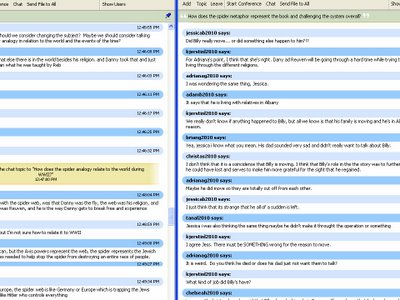


The students signed up for accounts through Skype and added me to their contact list. We made sure to communicate with the students the importance of not publishing any personal information over the Internet and encouraged them to use their Blogger display name along with an additional set of characters as their Skype username (both for safety and to create a unique username).After a few glitches, we were able to get everyone added and connected to one another. We completed some initial test runs with practice questions balancing two chat sessions occurring at the same time. We displayed the conversation side by side on their screens as well as projected onto the screen at the front of the classroom. At first it was truly mesmerizing to see how fast they were posting. However, it raised some interesting pedagogical questions regarding depth and quality of insight. My hope of using Skype versus Blogger was to use multiple online conversations with the outer circle in tandem with the inner circle conversations of the fishbowl. With Blogger, we created one post and the students commented on that. Even if we created multiple posts in Blogger, it would be difficult for students to follow multiple conversations due to the refresh issues.

When using Skype with the Fishbowl technique, I was looking for how it enhanced or detracted from the conversation. With Skype students noticed the conversation moved at a much faster pace allowing for them to comment more frequently, but at the same time, they put less thought into what they posted. Once again we, as a class, went back to the drawing board establishing Skype guidelines while reflecting on our Blogging guidelines. We had to focus on what it was we did well and liked about Blogger, but at the same time how could we make Skype better while increasing our learning and collaboration without sacrificing the quality of conversation.

It was really amazing to see them connect so easily to one another in the two smaller outside circle groups. I had split up the outer circle into the two smaller conversations so that the connections could be more instantaneous and lively. I also enjoyed hearing and seeing their connections between the conversations from the inner and outer circle as well as between the two Skype conversations. They did a much better job after reflection and analysis of referencing one another, using complete sentences, and expressing complex thoughts. In addition, since we are using an inquiry based approach to this entire semester focusing on the question of “what does it take to challenge the system?” I have been impressed to see how easily the students connect back to previous pieces of literature we have studied (Macbeth, Inherit the Wind, The Chosen, Fahrenheit 451) as well as referencing common themes and motifs they see reoccurring through each (appearance v reality, relationships between men and women-marriages, hands, eyes, challenging the system, price of progress, ambition, power).

Skype is still up for debate, but the students really seem to see the value in it as seen from their commenting to the posts regarding its trial run in class. Also, within the links below, please read through the transcripts of their conversations :

http://annesmith9h.blogspot.com/2006/11/chosen-fishbowl-1-3-period-2.html

http://annesmith9h.blogspot.com/2006/11/chosen-fishbowl-1-3-period-5.html

http://annesmith9h.blogspot.com/2006/11/reflecting-back.html

The Chosen Period 2 Fishbowl Group One

The Chosen Period 2 Fishbowl Group Two

The Chosen Period 5 Fishbowl Group One

The Chosen Period 5 Fishbowl Group Two


As for me, the verdict is still out on Skype. I am impressed by my students’ abilities with multi-tasking and the quality of conversation available to them through Skype. I agree that it is much faster paced allowing for their conversation to develop as fast as they want; but at the same time, I appreciate it more when they slow down and listen to one another. It was really important to have a conversation with them about the purpose behind Skype and more importantly, behind fishbowl. After we completed a few Blogger and in class reflections, now they are doing a more comprehensive job commenting and connecting with one another using Skype than they did with Blogger. I guess I just thought that I would not have to re-teach the things they did so well with Blogger. In my mind, it just took longer to get them to that “good” place than it had previously.

Regardless of either using Skype or Blogger, the growth in my students’ learning with the use of these technological pieces and fishbowl has been tremendous. They connect every piece of text we have studied this semester to each other as well as see connections with themselves as learners and with the world around them. They can produce interesting, captivating thoughts and are learning to value one another’s opinions and insights. They are learning and teaching one another! Isn’t that what education should be all about? Before Blogger and Skype, I was the only one who could witness their growth as learners because the fishbowl had to feed through me before my students had access to the technology. Now that they have the technology they are able to see each other’s thoughts and growth as teachers and learners. This is NOT education as usual.
Read More

Romancing Your Computer

Diposting oleh fatih on Selasa, 28 November 2006

While 12 of my Honors American Literature students were in Hawaii, I decided do to a little experiment with the somewhat grumpy students who were left behind. I gave them the following objective: Develop your own understanding of American Romantic poetry based on the resources in your book; select and incorporate at least one extension, such as Romantic art, Romantic music, British Romantic poetry, or your own, original Romantic poetry. Use Photostory to present your findings.

I showed them how to use Photostory, helped them individually with interpreting tough poems, and then just gave them time. The results were impressive, and discussing the poems in small groups with individual attention was much more effective and engaging than discussing the poems with the whole class.

When we shared the Photostories in class, students voted on the following categories: Most Deeply Analytical, Most Sublime, and Most Creative and Entertaining. The winners are worth taking a few minutes to enjoy if you have time:

Kelm/Prado
Wilcox/Hunt
Crellin
Parietti/Lueders
Pullara/Harden
Read More

Social Studies and Videos

Diposting oleh fatih on Jumat, 03 November 2006

I hesitated to talk here about video, being a history teacher and all. But Barb's post on te Fischbowl inspired me to share.

Many of my students will tell you (or complain to you)that I can take a 30 minute video and turn it into a 3 hour tour as I stop the video and have so many discussions. I ususally believe that these conversations are more important than the video and the video is simply a vehicle for the conversations. The weaknesses in my methods tend to be my inability to stay on track time-wise with the department's curricular goals and the fact that most of the conversations are based on MY questions or observations that I ask the students to respond to. Rarely do they create the questions or pose the observations that become the video conversations.

So...what did I try? In A.P. Government, I have shown a video for the last 6 years called "Why Can't We Live Together?", a Tom Brokaw special that examined the issue of race, white flight, perceptions and self-fulfilling prophesies in a middle/upper-middle class suburb of Chicago that tends to mirror our world in many ways. The conversations in class can often be uncomfortable for some as we speak publically about an issue that few find comfortable. This time, as we watched the video, I held back from stopping it (for the most part). Instead, they blogged as we watched. They shared their observations and questions. We responded primarily through the blog and I only stopped to have a discussion based on a question or comment they had posted.

What did I think of the experiment?

There were some positives. Students, for the most part, were not passive watchers, but active participants with EACH OTHER. A number of good conversations were held, much like those in the past. Some students shared great resources or anecdotes. We have a record of the conversation which is interesting to look back on to see how the conversations changed as they were presented with new information.

But, regardless of the positives, I'm not sure I like it. Some struggled with the multitasking. Much of what the video offered was missed or ignored. Instead, some students turned to a more generic discussion of race. While I like them having the conversation, the video offered some specifics that challenge or support many of the generic pieces. From many, those were missed. I watched a number of students only watch their laptop screen as they tried to keep up with comments.

Additionally, blogging is the wrong tool. Maybe something like skype would be better, but I had not yet created that capability in class. Blogging made the conversation very jumpy as responses to comment A are not seen until eight to ten other comments have been posted.

A few outsiders joined our conversation, one who threw gasoline on a fire. Because of the topic, I then had to be even more vigilant with each new post as I felt like I was no longer responsible just for what my students posted.

Will I try it again? Probably, but I will try a different tool, will discuss more the multitaking aspect and their responsibilty with the video info. But I suppose I should wait for them to respond before I decide.
Read More

Final Exams...Already?

Diposting oleh fatih on Jumat, 27 Oktober 2006

We started looking at material for the final exam in Astronomy class. While this assessment has the possibility to look like many things I started to think about the course title and how that could be a part of the final. The students have been doing a great job creating their own information for this class and the assignments that they have been given. The course title is "Planetary Astronomy." When thinking about this and the final I became interested in what the students thought about the class. I have spent a lot of time during the past few years taking the students on what seemed to be a tour of the Solar System and have not given them the time to take their own tour. With the computers in the class, I think that they could gather enough information to design their own tour. The software is there (Photostory) and the internet (along with print sources) could provide ample information for the students.

If anyone has thoughts or ideas of how this could look please let me know. I think it will be a good project but there are some questions that I still have and some that I am sure I have not thought of. I really do not know how I would grade this projects (or do I let the students grade themselves?).
Read More

Fishbowl 101

Diposting oleh fatih on Rabu, 25 Oktober 2006

When I was in college, I had some wonderful professors (Dawn Duncan and Jim Postema- Concordia College) who not only taught us how to think for ourselves, but also challenged us to teach one another. Recall the phrase, to teach is to learn. This might not seem like a big deal, but to ask sophomores and juniors in college to teach their classmates a novel per week complete with criticism as well as facilitating a conversation for an entire college class period was a daunting task. This is where the fishbowl began.

When I began teaching a senior level English class at Arapahoe, I became frustrated that I was to be the center of their learning. These kids have spent three years listening and watching their teachers teach; why couldn’t they be the expert on a piece of literature? However, I felt that they could not simply teach an entire piece of literature to one another in one week. So one day, I talked to the kids about how I learned in college and the difference it made in my learning to teach something rather than simply sitting back to listen to what my teacher told me to think about a novel. They were truly interested in the challenge of trying out fishbowl. They wanted their education to be different. I sat down and talked with our “new” instructional coach, Ray Hawthorne, and we talked through what changes would be necessary to make this work for high school. I decided that students would need to know how to ask good questions (higher level thinking questions), how to facilitate a conversation while still being able to get their point across, how to manage the classroom, how to look for criticism and understand the criticism they found, as well as actually understand what they read.

After much refinement, discussion, trial and error, and more trial and error as well as feedback from that first group of seniors ( the feedback is essential every year to tweak it to what best benefits the students), the fishbowl emerged.

There have been times it has not worked with a particular group of kids. There have been times it has simply blown my mind to see what they have come up with. [Please make sure to reference the handout as you read this section to understand the layout of the fishbowl] In the beginning, the outer circle merely reacted to the conversation in a journal format (only I would see these reactions). However, now we have many variations to the outer circle. We have also had the students T-note the questions from the inner circle and reacted to these. Other times students used a discussion tracking method keeping track of who said what and the reaction from those statements. Now my classes are live blogging on the outside so that there are actually two separate conversations occurring. Sometimes these conversations intertwine and sometimes they go in two separate directions. Either way, the best part of it is that the students are reacting to one another. I become a participant in their conversation rather than the director. That being said, sometimes I need to be a facilitator. I participate in the conversation with my freshman and sophomores, where with my seniors I stay out of the conversation and become an observer. (Actually this was a request from my first group of seniors who noted that every time I tapped into the conversation, the kids would take what I say as gospel. They thought it best to keep me out and they would grant me the last ten minutes of class to say what I think-they were so generous! I usually negotiate this piece on a class by class basis asking how much they want me to be involved).

How do the kids prepare? There are a few ways: one, the kids decide their own groups and can choose from a set of predetermined dates to present on. By allowing the students to create their own groups, they have more control, autonomy, and decision making ability than with pre-assigned groupings. Two, the kids read their assigned section, meet and discuss on what will be the focus of the conversation. They compose a syllabus for the class discussion which they turn in ahead of time to me for feedback. They must also find criticism to extend, support, or challenge our thinking on their assigned chapters. The criticisms often allow for the students to create great blogging questions for the class to react to after our fishbowls. The classes are often very good at making sure topics from previous discussion are referenced but they tend to hold each other accountable when one topic becomes too repetitive. My freshmen come with their own individual questions - they do not meet as a group ahead of time. They each create three higher-level questions which we post on the blog, write on the chalkboard or change the discussion direction.

As previously stated, teaching the kids good questioning strategies, methods for facilitating a discussion, and frequently asking for their feedback about how it went and what suggestions they have for improvement is so important.
Read More